
Choosing a corporate branding agency in Saudi Arabia starts with finding a partner whose strategic approach supports your organisation’s goals. Assess how the agency connects brand direction to business needs, explains its process, and helps teams apply the identity consistently.
For marketing leaders, the decision also means aligning stakeholders, priorities, and implementation. This guide offers practical ways to assess agency capabilities, review project evidence, and decide whether Zamakan Agency’s branding and related marketing services fit your needs.
• Assess whether the identity is planned for Arabic and English from the outset, including how it will work across your organisation’s key materials.
• Connect brand positioning to your business direction, audience and intended place in the Saudi market before defining the visual identity.
• Evaluate agency work by the clarity of its project evidence, team roles and approach, not by testimonials or claims alone.
• Consider how branding, advisory, media and SEO/SEM can support connected marketing decisions, then identify the next step that fits your priorities.
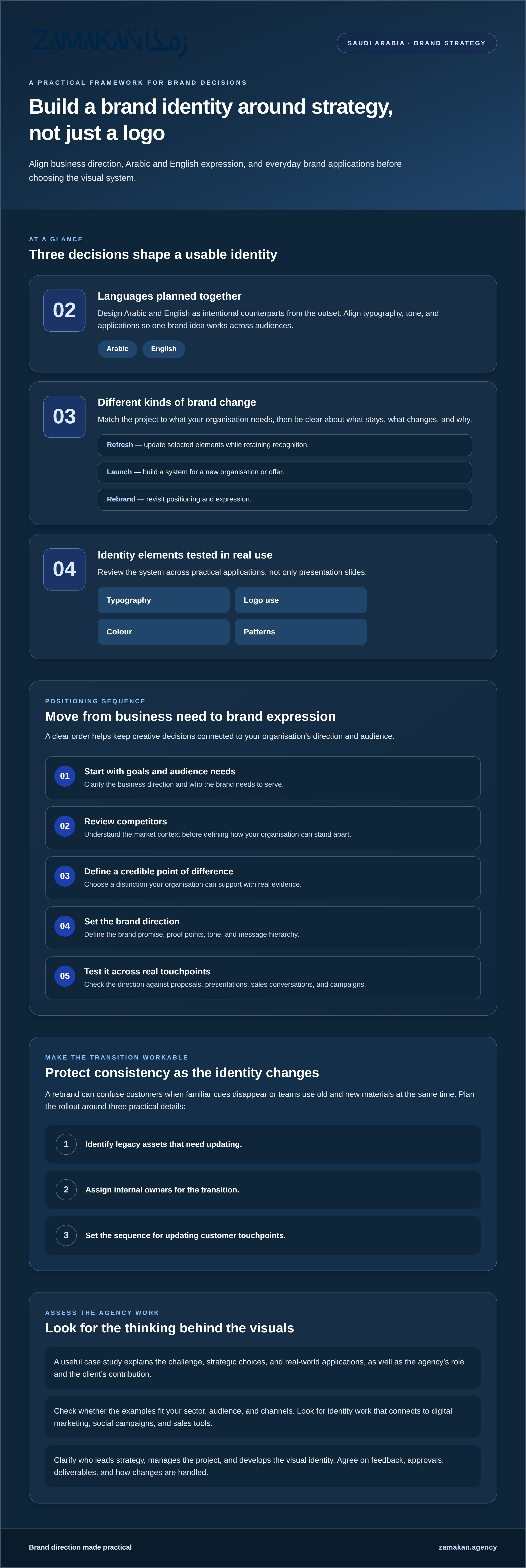
For Saudi organisations, plan Arabic and English identity together from the outset, rather than treating bilingual design as a later adaptation. Align typography, tone, and applications so one brand idea works across audiences.
An identity refresh updates selected elements while retaining recognition. A launch builds a system for a new organisation or offer; a rebrand revisits positioning and expression. For example, a Saudi B2B company might retain its name while updating its identity across proposals, presentations, campaigns, and digital channels. Assess what stays, what changes, and the reason for each decision.
Saudi culture, Arabic language, and local market context influence how a brand communicates meaning and credibility. Treat Arabic and English as intentional visual counterparts, and review fonts and applications across relevant government, commercial, and digital contexts. A hospitality brand, for instance, may need a different tone and customer-facing expression from an industrial supplier.
Rebranding can confuse customers if familiar cues disappear or teams use old and new materials at the same time. A transition plan should identify legacy assets, internal owners, and the sequence for updating customer touchpoints.
A structured project starts with discovery: business goals, audience needs, current perceptions, and market context. Strategy then defines positioning, brand promise, and tone before visual identity development begins. Test Arabic and English typography, logo use, colour, and patterns across real applications, not just presentation slides.
Timelines depend on scope, decision-making, and feedback. A focused refresh may require fewer deliverables than a launch or full rebrand. Set approval stages for strategy, visual directions, and final guidelines, and appoint one decision owner to coordinate feedback. This keeps identity work tied to business needs and consistent across sectors and campaigns.
When evaluating a corporate branding agency in Saudi Arabia, ask how it approaches Arabic and English identity and which applications its work covers. A complete identity system should connect its visual elements and tone to practical brand guidelines, rather than stopping at a logo.
Brand development begins with business direction and audience needs, then defines the value the organisation can credibly claim. A Saudi logistics company targeting enterprise clients, for example, might position itself around dependable delivery. That choice should guide creative work, messaging, and channel selection, with each identity element reinforcing the positioning.
Saudi businesses should account for applicable rules on company names, trademarks, and advertising. Requirements can vary according to the entity, mark, activity, and presentation of claims. Treat naming, trademark protection, and campaign review as distinct checks in brand development.
Build positioning through a defined sequence. Begin with business goals and audience needs. Review competitors, then define a credible point of difference. Set the brand promise, proof points, tone, and message hierarchy. For a Saudi B2B entity, proof might include its service process, technical expertise, or sector knowledge. These choices keep English messaging aligned with local commercial context. Test the direction against proposals, presentations, sales conversations, and campaigns.
Brand architecture clarifies how a parent company and its divisions relate. A group entering a new sector, for example, might use an endorsed sub-brand rather than create a separate identity. This can retain parent recognition while giving the new offer its own name. Compare that approach with a single master brand across services, then choose the structure that helps audiences understand both the offer and its source. Positioning should guide naming, visual identity, and future campaigns as one system. Ask the agency to show how strategic decisions translate into business touchpoints.
Review case studies for the challenge, strategic choices, and real-world applications. A Saudi energy company, for example, may need a clearer identity for recruitment, investor presentations, and corporate communications. Useful evidence explains how the work moved from the brief to the outcome. Look for the reasoning behind the decisions, not only polished visuals. Client reviews can provide context, but they are not a substitute for detailed project evidence.
Check whether examples match your sector, audience, and channels. A hospitality identity should show customer-facing applications, while a government supplier may need clear business materials. See how the agency connects brand strategy to digital marketing, social campaigns, and sales tools. This reveals whether the identity can guide daily decisions, not just a launch presentation. A useful case study also clarifies the agency’s role and the client’s contribution.
An agency’s location matters chiefly for collaboration, not as a measure of quality. For a nationwide project, agree on workshops, review stages, and communication methods that suit stakeholders across Saudi Arabia. When making an enquiry, outline the business challenge, audience, current materials, decision-makers, and required applications. This helps define the project scope and relevant team roles.
Clarify who leads strategy, manages the project, and develops the visual identity. A naming specialist may be useful for a launch requiring a new name; a brand strategist can refine positioning and messaging. Ask how feedback and approvals are coordinated. Request a proposal that ties the scope to deliverables, research, revisions, and rollout support. Compare responsibilities, scope, and deliverables. The project should state what is included and how changes are handled.
Agencies have different strengths: some focus on brand strategy, while others specialise in naming, identity systems, or rollout. Compare their stated services, relevant project evidence, and client reviews. Strong case studies explain the business challenge, strategic direction, and resulting applications. This helps you weigh reputation against demonstrated work instead of relying on broad claims or polished visuals alone.
Vision 2030 has pushed thousands of new companies into a competitive Saudi market. A clear brand vision helps an organisation express its purpose and distinct value. Assess how an agency connects that direction to naming, messaging, and guidelines. For example, a technology company entering the market may need a different position from an established industrial group. The strategy should reflect that difference.
Startups, SMEs, and large enterprises can all need branding, but their project requirements differ. A startup preparing to launch may need naming and a focused identity system. An SME reaching new customer segments may need sharper positioning. A large enterprise with multiple divisions may need brand architecture and coordinated guidelines. Choose an agency whose approach fits your organisation’s decisions, stakeholders, and intended applications.
Compare each agency’s strategic approach, team roles, sector experience, and approval process. For a business operating nationwide, assess how the team will coordinate workshops, stakeholder feedback, and reviews across locations. Check whether its guidelines cover everyday use in presentations, digital channels, and campaigns. A suitable partner can explain its direction, show how it informs the work, and clarify how teams can apply the identity consistently.
The right agency is not necessarily the one with the broadest offer, but the one whose capabilities match your needs, from strategy and naming to identity systems and rollout. Consider reputation alongside relevant project evidence and client reviews. Look for work that connects a clear business challenge to strategic direction and practical applications.
One listed provider assigns 75% of its services to branding. Sortlist lists 135 branding agencies in Saudi Arabia, offering a broad field for comparison.
zamakan Agency can support organisations seeking branding aligned with business priorities. It develops and implements tailored marketing strategies, alongside branding and brand identity services. When a launch or repositioning calls for clearer strategic choices, zamakan’s advisory work can shape a marketing strategy around your business context.
For a campaign, for example, an organisation can align its brand concept with the message, audience, and channels. zamakan’s media planning and buying can then inform decisions about reaching that audience. This helps keep brand expression and campaign planning aligned, while your organisation sets its priorities, approvals, and measures of success.
Digital visibility may also need attention as the brand develops. zamakan’s SEO/SEM services include technical and content audits to identify performance gaps and improve search visibility. These audits provide a practical basis for refining digital marketing, rather than treating search as separate from the brand’s wider position. The right focus depends on your challenge, such as an unclear message, a campaign requirement, or search performance that needs review.
Before a project discussion, prepare your business objectives, intended audience, current materials, and the decisions your team needs to make. Include relevant channels or campaigns and internal approval requirements. This gives the conversation a clear foundation and connects branding, advisory, media, or SEO/SEM to your priorities. Contact zamakan Agency to discuss your branding needs.
A branding agency serving organisations nationwide can help create a consistent identity across teams, channels, and customer touchpoints. The project scope determines the deliverables, which may include strategic direction, identity elements, and guidance for applying them. Shared brand guidance, for example, can help distributed teams keep presentations and campaign materials aligned.
Zamakan Agency is one option for organisations seeking branding support in Saudi Arabia. Agencies across the market vary in focus, from identity development to broader brand strategy and campaign work. To assess fit, map your immediate business need to the agency’s relevant capabilities and project approach. Consider how the proposed work will support your organisation after the initial identity is delivered.
Look for agencies that connect corporate identity to strategic decisions and explain how each informs the other. Review whether their work links organisational goals to real identity applications. A business consolidating several departments, for example, may need its identity to clarify how those teams relate while maintaining a coherent corporate presence.
Depending on the brief, services may include brand research, positioning, naming, identity development, corporate communication, and brand guidelines. Some projects also apply the identity to campaigns or digital channels. A practical way to define the need is to identify where your current brand creates friction, such as inconsistent presentations or unclear messaging, then set priorities for the project.
Set out your organisation’s objectives, intended audiences, existing brand materials, and the decisions the work should support. Identify key stakeholders, approval responsibilities, and the channels where the identity will appear. If sales and recruitment teams both use corporate materials, include both use cases so the project can address their distinct communication needs.
Project duration depends on scope, deliverables, stakeholder input, and approvals. A schedule should identify stages such as discovery, strategic direction, identity development, review, and handover. Agreeing on who consolidates feedback can help prevent conflicting revisions. If the work covers several departments, include their input and approvals in the project timeline.


