The SEO agency that fits your business is not necessarily the largest or most visible. A useful SEO agency comparison across Saudi Arabia starts with the work each provider delivers and how clearly it reports on progress and leads. Your shortlist may include specialist SEO firms and broader digital marketing agencies, with different capabilities and reporting approaches.
A list of company names is not enough to make a sound decision. Compare each agency’s scope with your business goals, target customers, website needs, and the evidence it uses to assess performance.
This guide explains how to compare proposals, reporting, and agency approaches for businesses targeting Saudi Arabia, using hubs like Riyadh as an example. It also covers how Arabic and English search needs, relevant work, and clear next steps can inform your decision when partnering with zamakan Agency or other providers.
• Assess reporting by whether it connects search activity to qualified leads, completed work, and clear next steps.
• Compare how each agency approaches local visibility, Google Maps, and the locations your business needs to reach.
• Look for transparent methods, realistic commitments, and clear ownership of your analytics and website data.
• Match an agency’s SEO capabilities to your language needs, website platform, and wider marketing priorities.
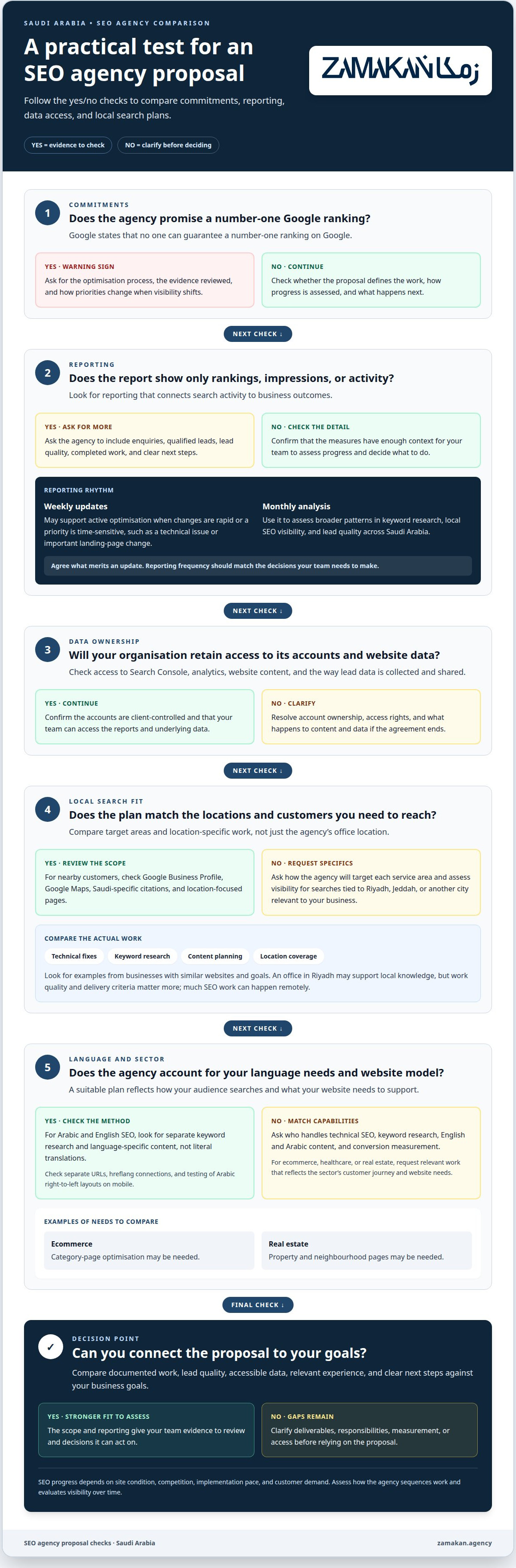
Separate measurable commitments from promises about rankings. Google states that no one can guarantee a number-one ranking on Google. Ask each agency to explain its optimisation process, how it monitors search changes, and how it adjusts priorities when visibility shifts. A clear plan specifies the work, the evidence reviewed, and the next steps.
Reporting should connect search activity to business outcomes. Compare reports that show impressions alone with reports that also track enquiries, qualified leads, and lead quality. For example, a Riyadh service business needs to know whether organic search brought relevant enquiries, not simply whether a keyword moved. Monthly reports should summarise completed work, changes, and next steps.
Weekly reporting can support active optimisation when a campaign has rapid changes or a time-sensitive priority. Agree on what merits a weekly update, such as a technical issue or an important landing-page change. Use monthly analysis to assess broader patterns in keyword research, local SEO visibility, and lead quality across Saudi Arabia. Reporting frequency should match the decisions your team needs to make.
Data ownership matters too. Search Console, analytics, and website content should remain under your organisation’s control. Confirm that reports use accounts your team can access and explain how lead data is collected and shared. Social media metrics can provide context, but they should not replace search and lead measures.
| Agency approach | Guarantees | Reporting | Data access |
|---|---|---|---|
| Ranking-led | Promises positions | Keyword movement | Clarify account ownership |
| Activity-led | Defines deliverables | Tasks and changes | Confirm access rights |
| Lead-focused | No ranking certainty | Leads and lead quality | Client-controlled accounts |
Choose an approach that connects documented work with lead quality, accessible data, and decisions your team can act on.
When reviewing reports, ask whether they connect enquiries to lead quality, rather than presenting impressions or activity in isolation. Agree on the measures and context your team needs to evaluate the engagement and decide what to do next.
For a Riyadh business serving nearby customers, local SEO should connect Google Business Profile, Google Maps, Saudi-specific citations, and location-focused pages. Compare how agencies target each service area, then assess visibility for searches tied to Riyadh, Jeddah, or another city. An agency’s Riyadh office can support local knowledge, but its work quality and delivery criteria matter more; much SEO work can happen remotely.
Agencies vary in their services, specialist expertise, and the evidence they share about client results. Compare technical fixes, keyword research, content planning, and location coverage with examples from businesses that have similar websites and goals. A useful comparison checks whether proposed work addresses your actual search competition, rather than relying on broad claims.
For ecommerce, healthcare, or real estate, prioritize agencies that show relevant experience with the sector’s customer journey and website needs. An ecommerce store, for example, may need category-page optimisation, while a real estate firm may need property and neighbourhood pages. Compare the specific work and outcome measures presented for each industry.
For Arabic and English SEO, look for an agency that treats each language as a distinct search experience. Pages for the Saudi market should use separate keyword research and language-specific content, not literal translations. Compare how providers structure language versions on separate URLs, connect them with hreflang, and test Arabic right-to-left layouts on mobile.
An SEO plan should cover technical SEO, content, local listings, and target locations. Progress depends on site condition, competition, implementation pace, and customer demand. Ask how the agency will sequence fixes and assess visibility over time. Your SEO agency comparison in Riyadh should favour a plan aligned with your target markets, language needs, and business model.
Use the hiring discussion to test an agency’s method, then examine contract terms before signing. In Saudi Arabia, Google’s guidance makes guaranteed number-one rankings a clear warning sign.
This stage tests how a potential partner will work with your team, rather than simply presenting credentials. Ask who handles technical SEO, keyword research, English and Arabic content, and conversion measurement. Request Saudi-client ranking or traffic data, plus two contactable references in your sector. Ask how the agency defines qualified leads and reports progress when rankings change.
Before signing, compare the proposal’s tasks with its reporting schedule and contract terms. Confirm who approves website changes, how completed work is recorded, and what happens to Search Console, analytics, and content if the agreement ends. Clear answers help your team assess accountability, access, and scope instead of relying on a polished pitch.
Warning signs include guaranteed positions, vague deliverables, and unexplained link-building methods. Google states that no one can guarantee a number-one ranking on Google. Google’s spam policies also prohibit bought links. Ask the agency to explain its approach and how it avoids practices that can harm search visibility.
Use evidence to distinguish a credible proposal from unsupported claims of authority. Ask for relevant traffic or ranking examples, clear responsibilities, and a sample report showing completed work and next steps. Confirm that your organisation retains access to Search Console, analytics, and content. An agency that will not explain its methods or reporting makes accountability harder to assess.
Compare each response with your goals, such as technical improvements, relevant keywords, and qualified conversions. Choose a partner whose methods, account access, and reporting commitments are specific enough to assess throughout the engagement.
Start with a shortlist of three SEO companies with published work similar to your website. Compare each proposal against a business goal, such as qualified enquiries from Riyadh searches. Review relevant examples, the named team responsible, and the sequence from diagnosis to implementation. An agency’s Riyadh office can add local context, but work quality and service criteria matter more; most SEO work can be done remotely.
For the Saudi market, assess Arabic and English as distinct search experiences. Strong plans use language-specific keyword research and pages, not literal translations. Check whether each Arabic page has an English counterpart on a separate URL, linked with hreflang. Ask how teams assess Arabic right-to-left layouts, number formats, and structured data on mobile. These details show whether the strategy reflects language and user needs.
Next, compare the technical SEO plan with your website platform. Salla, Zid, Shopify, and WooCommerce have different capabilities that can affect SEO changes. Ask each company to explain how its proposed technical work fits your platform. For example, a migration plan should account for how that platform handles page addresses and redirects, rather than assume all stores work alike.
Use the same decision criteria for all three candidates: similar published work, Arabic and English capability, technical scope, and a clear sequence of priorities. Then compare how each proposal connects search engine visibility with your target audience and business goals. A local specialist may suit a Riyadh-focused business; a regional agency may fit a company serving several Saudi cities. Choose the partner whose evidence and plan match your website, language needs, and intended markets, not simply its office location.
zamakan Agency can help when your search strategy needs clearer priorities, better coordination, or a more accountable path from analysis to action. Its advisory work can align SEO decisions with business goals, audience needs, and wider marketing activity. This is useful when search plans are disconnected from the rest of your digital marketing.
For a focused review of website performance, zamakan Agency’s SEO/SEM technical and content audits can identify issues affecting search visibility and content relevance. The findings help your team decide what to address first, where internal input is needed, and how to assess progress. A defined scope keeps the work connected to business outcomes.
Media planning and buying can be relevant when organic search needs to fit within a broader audience and channel plan. Branding can support consistency when search content and wider communications present different messages. The right starting point depends on your priorities and the relationship between search, audience, and brand needs.
Contact zamakan Agency to discuss your priorities and start a conversation about your search strategy.
Businesses can compare specialist SEO firms with broader agencies that include search in wider marketing work. For an SEO agency comparison in Riyadh, assess each provider’s fit with your website, sector, language needs, and target markets. Zamakan Agency provides SEO/SEM, including technical and content audits. Clarify who will lead the work and how the plan addresses your organisation’s search priorities.
Prioritise detailed reviews that describe the work and business context, rather than relying on a star score alone. Look for consistent feedback about communication, reporting clarity, and follow-through. Compare reviews on the same independent platform, and read critical comments as well as positive ones. Ratings are most useful when the details match your needs and the agency’s proposed work.
A practical SEO agency comparison in Riyadh starts by matching proposals against the same business goals and website needs. Compare technical analysis, content work, local visibility, measurement, and responsibility for each task. Ask agencies to explain what their deliverables address and how they will assess progress. This makes differences in scope clear and helps you identify a plan that fits your priorities.
Ask for a case study’s starting point, target market, website type, and measurement method. Traffic growth alone may not show whether relevant customers arrived or converted. Compare the stated work with the reported outcomes, then ask a reference about communication and delivery. For ranking examples, clarify the search terms, language, and location to understand what the visibility data represents.
A local SEO plan can cover Google Business Profile details, relevant business categories, service areas, and location-specific pages. If your company has branches, check whether each profile and page reflects the correct branch information. Ask how the agency handles customer reviews and maintains consistent business details across relevant listings. These details help you assess whether its approach fits your operating model.
Compare contracts for defined deliverables, responsibilities, approval processes, account access, and termination terms. Agree on KPI definitions before work begins, distinguishing qualified enquiries from all form submissions and documenting how calls or other lead actions are attributed. Reports should explain changes and their rationale, not just impressions. Clarify who retains access to analytics accounts and website content if the engagement ends.