
A corporate branding strategy is more than a logo or campaign. It sets the direction for how people understand your organisation across its communications, services, and customer interactions. The challenge is to build a distinctive identity that stays coherent across teams and markets, including the varied audiences and business contexts in Saudi Arabia.
Learn how to define your strategy, track indicators such as brand awareness, sentiment, and employee alignment, and assess whether your internal culture supports the reputation you present externally. We’ll also look at how established brands adapt their expression without losing their core identity, helping you evaluate examples and make informed decisions about your own brand.
• Clarify how your corporate identity relates to individual products and services before expanding the portfolio.
• Choose measures that connect audience perception and employee alignment to your organisation’s priorities.
• Keep the brand’s core position consistent across markets while adapting its expression to local audiences.
• Use examples to assess how brands balance recognition, distinctiveness, and relevance as they evolve.
A corporate branding strategy defines how an organisation presents its identity, purpose, values, and vision to stakeholders. It connects the parent company with its portfolio and sets direction for products, services, and communications across Saudi Arabia.
Brand architecture defines the relationships between a company, its business units, and its product brands. Portfolio management applies that structure to decisions about which brands to retain, grow, combine, or retire. Procter & Gamble uses a house-of-brands model, presenting Tide, Pampers, and Gillette as distinct brands. Each product line can build its own identity, while the portfolio structure clarifies brand roles and investment priorities.
Corporate brand architecture sets the hierarchy between a parent identity and the brands beneath it. Common models include a branded house, a house of brands, and endorsed or hybrid structures. A branded house uses one corporate name across its offers; a house of brands gives products distinct names; an endorsed model connects product identities to a parent. The choice shapes how stakeholders understand shared reputation, product promises, and the organisation’s position.
In Saudi Arabia, review branding and advertising materials against applicable local requirements before publication. The relevant considerations include the sector, the claims being made, and the communication channel.
Develop the strategy by auditing existing brands and stakeholder views, defining purpose and position, and selecting an architecture model. Translate these decisions into messaging and visual guidelines, then plan how to roll them out across customer touchpoints.
Common risks include overlapping brand roles, inconsistent guidelines, and portfolios that confuse customers. Applying one corporate identity to every offer can limit distinct positioning, while separate brands may make the connection to the parent less visible. Choose an architecture that fits the organisation’s portfolio and intended reputation.
Corporate branding encompasses how a company presents itself through its products, services, documents, and employee interactions. Guidelines carry the chosen identity into routine communications, helping the parent company remain recognisable while portfolio brands retain clear roles.
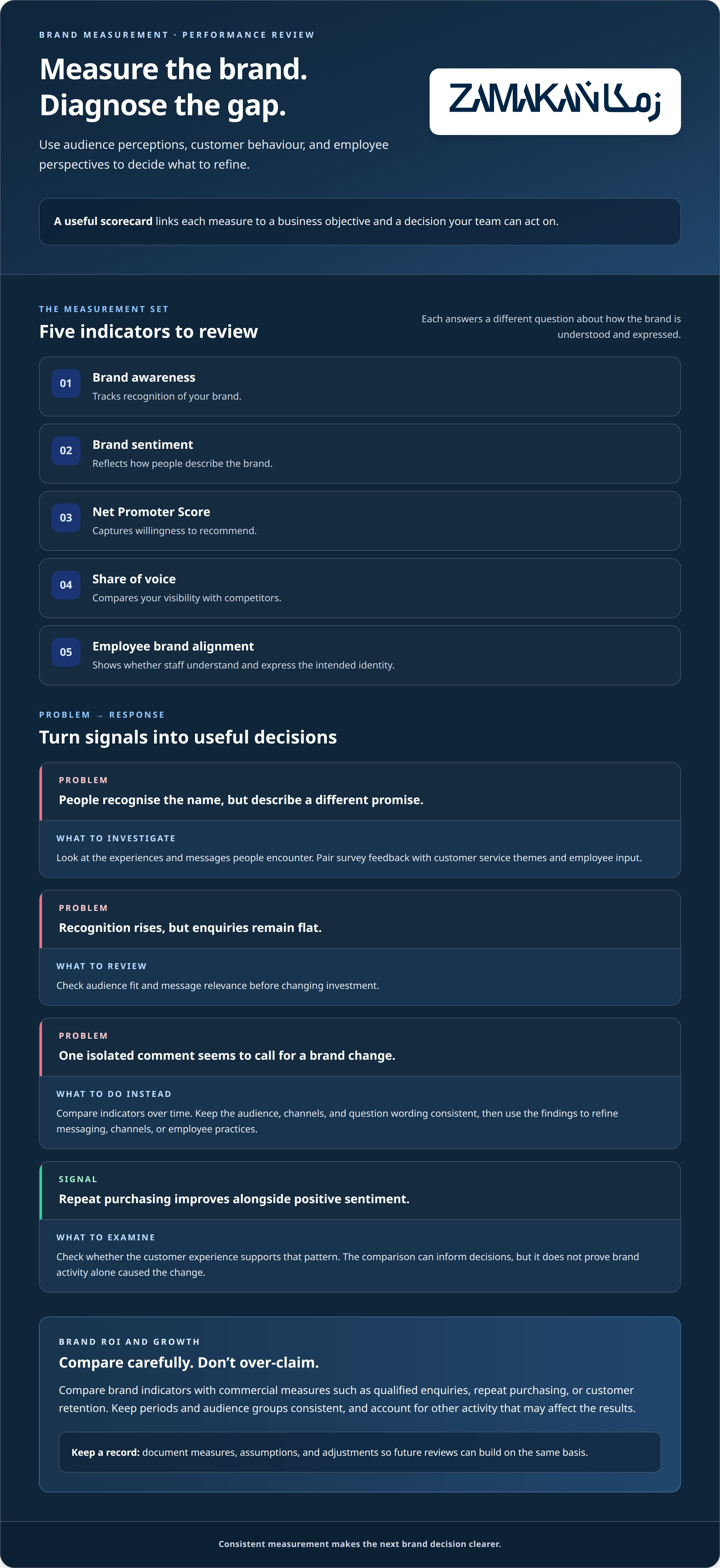
Brand measurement combines audience perceptions, customer behaviour, and employee perspectives to assess whether your brand direction is working. A useful scorecard links each measure to a business objective and a decision your team can act on.
Review performance by comparing brand indicators over time, then use the findings to refine messaging, channels, or employee practices. Five useful measures are brand awareness, brand sentiment, Net Promoter Score, share of voice, and employee brand alignment. Awareness tracks recognition; sentiment reflects how people describe the brand; Net Promoter Score captures willingness to recommend. Share of voice compares your visibility with competitors, while employee alignment shows whether staff understand and express the intended identity.
Set a consistent review schedule and compare like with like: use the same audience, channels, and question wording. Pair survey feedback with customer service themes and employee input. If customers recognise your name but describe a different promise, investigate the experiences and messages they encounter. This helps your team identify where to refine the brand instead of changing its identity in response to one isolated comment.
Brand return on investment (ROI) examines how brand-building relates to business outcomes without attributing every sale to a single campaign. Compare brand indicators with commercial measures such as qualified enquiries, repeat purchasing, or customer retention. Keep the periods and audience groups consistent, and account for other activity that may affect the results.
If recognition rises while enquiries remain flat, for example, review audience fit and message relevance before changing investment. If repeat purchasing improves alongside positive sentiment, examine whether the customer experience supports that pattern. These comparisons inform data-driven decisions, but do not prove brand activity alone caused a commercial change. Document the measures, assumptions, and adjustments so future reviews can build on the same basis.
A strategy review tests whether your brand’s positioning still fits the organisation, its audiences, and its markets. Corporate branding sets long-term direction; marketing translates that direction into campaigns for specific products, services, and periods. The distinction also clarifies accountability: corporate leaders guide the organisation’s reputation, while product teams shape how individual offers are presented. Reviewing both together helps prevent campaign decisions from drifting away from the company’s intended position.
Across Saudi Arabia, local execution should reflect the audiences and business contexts an organisation serves. Research, customer feedback, and channel performance can reveal where communication needs to adapt. A business serving institutional buyers and consumers, for example, may need different proof points for each group while maintaining one consistent corporate position. This lets teams speak to their audiences without treating the national market as a single, uniform segment.
Every marketing channel creates a different point of contact, from corporate communications and social media to advertising and customer service. Review how the brand appears in each setting and whether the experience supports its intended promise. A campaign can use a distinct format or message, but its claims and tone should still feel part of the same organisation. Documenting channel-specific decisions clarifies responsibilities and helps teams maintain consistency during execution.
Digital marketing can provide ongoing feedback on how audiences respond to messaging, visuals, and technology. Use that feedback to identify meaningful changes in customer expectations rather than reacting to isolated comments. A strategy review should also revisit the organisation’s competitive position, portfolio changes, and operating context. When these factors point in a new direction, leaders can decide whether to refine campaign expression or reconsider the broader brand position. This distinction helps protect brand equity while keeping activity relevant.
Lucidpress's State of Brand Consistency studies found that companies presenting their brand consistently across every channel saw revenue gains of 10-20%.
Strong examples reveal how a brand’s choices support its position, rather than simply making it look different. Mastercard’s 2016 rebrand removed the wordmark from many applications while retaining its interlocking circles. The visual system became simpler, yet the familiar symbol continued to identify the company. The lesson is to define what audiences already recognise before changing prominent brand touchpoints. A redesign should strengthen recognition, not treat novelty as proof of success.
Coca-Cola offers a different example: it maintains one core brand identity while tailoring campaigns to local cultures. The central promise remains recognisable, while campaign expression can respond to local references and audience expectations. This helps teams distinguish fixed brand elements from adaptable choices. In Saudi Arabia, local creative decisions should be grounded in audience understanding, rather than the assumption that one execution fits every customer group or channel.
Marriott Bonvoy illustrates an endorsed portfolio structure through brands such as Courtyard by Marriott and Residence Inn by Marriott. The parent identity connects the hotels, while each name retains a distinct role. For organisations managing several offers, this model can make relationships visible without erasing differences in audience or experience. The practical test is whether customers can understand both what connects the portfolio and why each offer is relevant.
Patagonia connects minimalist design and sustainability messaging with its environmental stewardship mission. Its example shows how visual choices, stated values, and organisational culture can reinforce one another across customer touchpoints. Brand equity grows when external claims align with what stakeholders experience. These examples offer different approaches, not one formula: Mastercard prioritises symbol recognition, Coca-Cola adapts campaigns, Marriott clarifies portfolio relationships, and Patagonia connects identity with mission.
Use these cases to assess whether your brand choices express a clear position across audiences and experiences. For expert support shaping a coherent brand identity, explore professional branding support.
zamakan Agency develops, audits, and executes branding concepts for campaigns and corporate communications. Its branding services can help when your organisation needs a clearer identity, more consistent messaging, or closer alignment between its brand and market activity.
Bring your priorities and the questions your team needs to resolve. zamakan Agency can help shape a considered next step for your branding needs. Contact zamakan Agency to discuss your requirements.
Connect brand intent with the decisions your teams make every day. A corporate branding strategy becomes meaningful when leaders use it to guide priorities, communications, and the experience customers receive. That requires clear ownership, shared criteria, and regular attention to how the organisation is represented.
Zamakan Agency brings together Advisory, Media, SEO/SEM, and Branding for organisations shaping their market presence. The team can help you assess where your brand direction needs definition and how it should guide marketing activity. Start with the business challenge you need to address, whether that is alignment, visibility, or a clearer corporate identity.
When you’re ready to move from evaluation to a considered plan, discuss your brand with Zamakan Agency. A clear next step can give your teams a stronger basis for purposeful, consistent decisions.
Align business units by setting shared brand principles and defining where each unit can make distinct choices. For example, a group with separate financial and logistics divisions might use one corporate identity while tailoring service messages to each audience. Clear approval roles, shared templates, and regular reviews help teams apply the same standards without making every unit sound identical.
Internal communications help employees understand what is changing, why it matters, and how the new direction affects their work. A rollout might pair a leadership briefing with team-specific examples, updated presentation templates, and guidance for customer-facing conversations. This gives staff practical ways to express the brand consistently and raise questions before inconsistent messages reach customers.
A corporate branding strategy connects an organisation’s purpose, values, positioning, identity, messaging, and brand architecture. It should also define how those elements apply across business units and customer touchpoints. For example, an organisation entering a new sector can use its positioning to decide whether its existing corporate name suits the offer or a separate brand would set clearer expectations.
Measure brand performance by linking perception indicators with commercial outcomes over a clear review period. Compare recognition, sentiment, recommendations, and employee understanding with qualified enquiries or repeat purchasing. If recognition improves but enquiries do not, for example, examine audience fit and message relevance before attributing business growth to brand activity.
A hypothetical Saudi organisation serving institutional buyers and consumers could retain one corporate identity while adapting its messaging and channel choices for each audience. The strategy would preserve shared brand principles, then assess whether each execution fits its intended market and business context. This is an illustrative approach, not a claim about a specific Saudi company or a measured outcome.


