
A brand awareness strategy for social media builds recognition among the people you want to reach, making your brand easier to notice and remember. Recall measures whether people can bring it to mind, while consideration reflects whether they would include it among their options.
Plan social media and advertising around your business goals, audience, channels, and measures. This gives your investment a clear purpose and lets campaign performance guide future decisions.
This guide explains how awareness, recall, and consideration relate, then explores the decisions that shape social media planning in Saudi Arabia and when specialist support can align strategy with execution.
• Use reach, impressions, and engagement rates to understand whether your social activity is building meaningful interaction.
• Separate recognition, recall, and consideration so your messaging and measures match the audience’s stage.
• Coordinate paid social and search around clear objectives, audience priorities, and consistent brand signals.
• Align channel choices and campaign planning with your business goals, and consider specialist support when strategy and execution need to work together.
Start with a baseline for reach, impressions, and engagement rate on each channel. Reach counts distinct accounts exposed to content; impressions count total displays. Engagement rate relates interactions, such as comments, shares, and saves, to a consistent audience or reach measure. Use the same calculation in every reporting period so results can be compared.
For social media advertising in Saudi Arabia, professionals plan around platform selection, audience size, campaign duration, and creative requirements. A SMART awareness goal identifies the target audience, intended action, measure, and review date. For example, a small business could aim to increase relevant profile visits, then assess progress against its starting baseline.
Choose platforms through audience research. Identify where customers discuss your category, then match each channel to suitable formats and your team’s ability to respond. Encourage interaction by asking a focused question, replying to comments, and answering messages. Personalize posts around customer needs, such as explaining how a service applies to different business types. These exchanges can help build a useful community.
Professionals can use influencers to introduce a brand to new audiences and customer-created content to add first-person perspectives. Before launch, define the campaign objective, audience, message, channel mix, publishing plan, and measurement approach. Reuse customer content only with permission, and keep its message aligned with the brand.
Common mistakes include tracking impressions without reviewing interaction, posting identical material across platforms, and leaving comments unanswered. A team should review performance regularly and adjust content or placement when results show a mismatch. For example, low saves on an educational post may signal that its topic or format needs refinement. Keep the brand message consistent while responding to audience signals.
Brand awareness means your target audience recognizes or knows about your brand. Recall goes further: people can bring your name to mind without seeing it. Consideration begins when they include your brand among options worth exploring. These stages call for different signals, from recognition in campaign responses to branded searches and enquiries.
Consistency helps connect those signals. Use the same logo, colours, tone, and core message across Instagram, LinkedIn, advertising, and customer service. For example, a hypothetical Saudi retailer could repeat its distinctive colour palette and promise across social posts and campaign landing pages. Adapt each execution to the platform while keeping the cues that make the brand identifiable.
How often should a brand post on social media? There’s no universal posting frequency for every brand. Set a sustainable schedule based on audience expectations, platform format, and your team’s ability to respond. A steady series of useful posts creates a more coherent presence than bursts of activity followed by silence.
Build a content narrative, not a stream of disconnected announcements. A hypothetical Saudi food brand could share ingredient stories, customer occasions, and product updates in a consistent voice. Adapt each story to the platform: an Instagram carousel may explain a process, while a LinkedIn post can explore its business context.
Carry the same promise through every customer touchpoint, including social profiles, campaign landing pages, and replies to messages. If an advertisement emphasizes clear delivery information, the landing page and customer service response should reinforce that expectation. Review campaigns for gaps in tone, visuals, and claims before publication. This connects impressions to a recognizable experience and gives people a clearer reason to consider the brand.
A brand awareness strategy on social media can pair organic publishing with paid placements. Organic activity develops through regular posts and community interaction; paid advertising lets a business direct selected messages to a chosen audience. Set the campaign objective first, then select placements and formats suited to the audience and brand message. Plan exposure carefully so repeat visibility supports recognition rather than causing fatigue.
Compare organic and paid activity by purpose. Organic posts help a team understand which themes prompt meaningful responses, while paid placements extend selected messages to audiences beyond existing followers. Assess performance using relevant signals such as reach, engagement, and branded search activity. Clicks alone may not show whether someone remembers a brand.
Search advertising reaches people as they look for relevant products or services, while email newsletter advertising places messages in a publication’s communication with subscribers. Online display advertising uses visual placements across websites. Each channel serves a different context, so align its audience and message with the campaign objective. A social media brand awareness strategy can work alongside these channels while keeping their roles distinct.
For example, a Saudi retailer could promote an authentic customer story through paid social, then reinforce its central message through display placements. Review the creative and placements during the campaign using measures tied to its objective. Keep the core identity consistent while adapting the presentation to each channel. This gives the advertising plan a coherent direction and helps teams assess whether exposure supports recognition and engagement. A social media brand awareness strategy should complement other advertising, not turn every placement into a disconnected task.
More than five trillion display ads reach the Internet every year. Meg Gowell describes testing always-on awareness advertising over 30 days. Awareness-focused paid social campaigns have a recommended cap of 2 to 3 impressions per user per week.
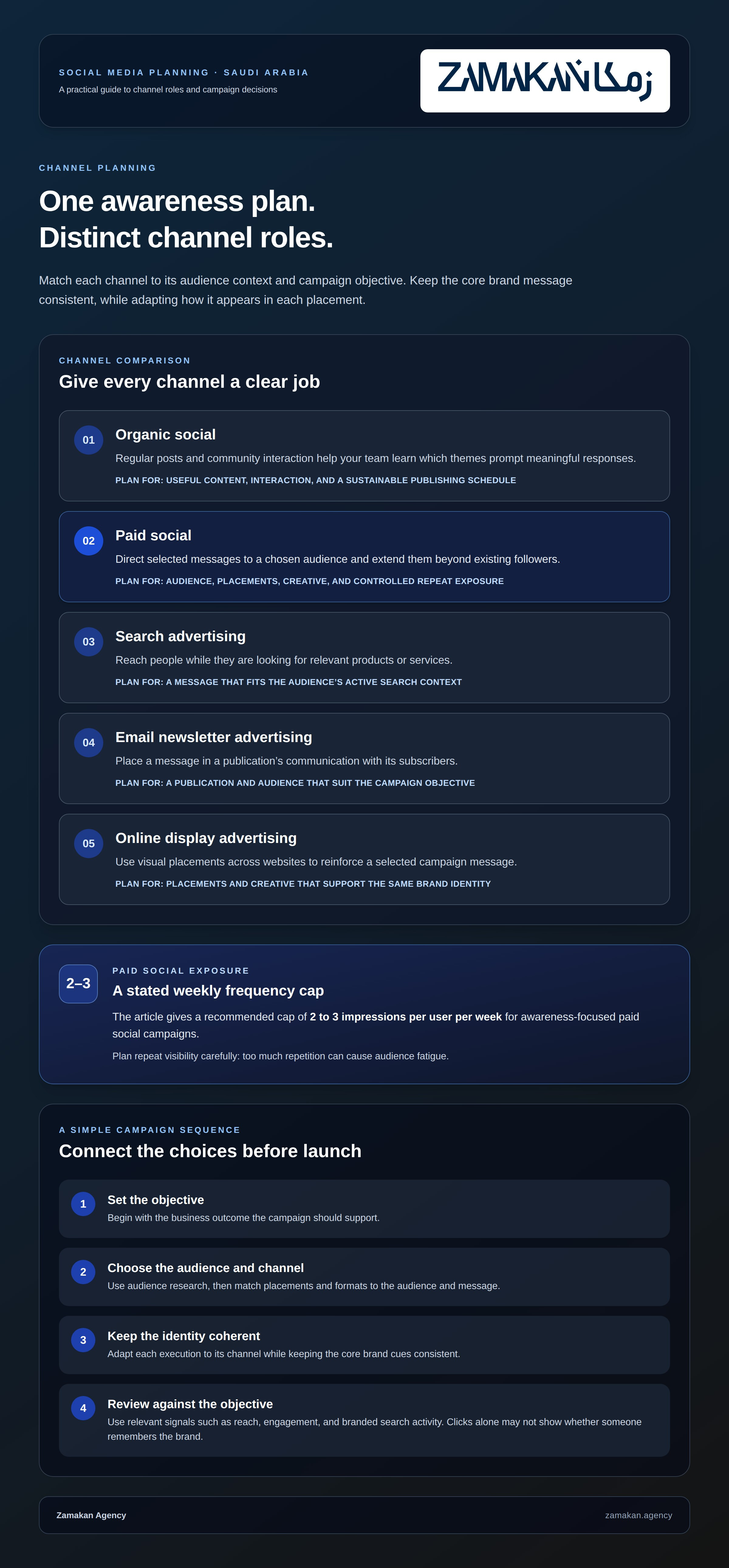
Begin with the business outcome, then choose activities that can influence it. For a small business serving customers across Saudi Arabia, a launch may need broad visibility, while a specialist service may benefit from reaching a narrower audience. Plan content, audience research, and measurement around clear objectives so each activity has a defined role. This prevents a channel from taking priority simply because it feels familiar.
Focus on two or three channels where ideal buyers spend time, rather than spreading activity across every platform. For example, a Saudi café might pair Instagram discovery with a channel where customers ask practical questions. A B2B consultancy might prioritize LinkedIn and search. These examples are not fixed prescriptions. Match each channel to audience behaviour, suitable content formats, and how your team can respond to comments and messages.
Set a baseline and give each measure a specific job. Reach shows how widely a message travels; impressions show repeat exposure; engagement signals whether consumers interact. Add brand searches, profile visits, or enquiries when they fit the objective. A high total alone does not define success. Compare results with the intended audience and campaign goal, then focus on messages that earn meaningful attention.
Build review points into the plan before launch. A scheduled check can catch audience fatigue, unanswered comments, or weak creative. A quarterly comparison can show whether awareness indicators are moving beyond short-term campaign activity. Plan to learn and adjust rather than locking every decision upfront. Document what changed, why it changed, and what the next review should assess. This record connects visibility, community response, and future planning.
zamakan Agency develops branding concepts for campaigns and corporate communication, giving your social presence a clearer, more consistent identity. This is a relevant next step when audiences see your posts but struggle to recognize what makes your organization distinct. A defined brand direction helps align campaign messages, visual choices, and the experience people encounter across channels.
Social Media advertising can extend selected messages to audiences who may not yet know your brand. Media planning and buying strategy connects those placements to campaign objectives, audience priorities, and measurement. This is useful when organic activity alone does not provide the visibility or reach your plan requires. The right approach depends on your audience, business goal, content, and channels.
Advisory can bring these decisions together when priorities are unclear or teams are working from disconnected plans. A focused discussion can start with your business objectives, existing brand materials, audience understanding, channel activity, and current performance measures. These inputs help shape decisions about the roles of branding, social media advertising, and media planning, without assuming every organization needs the same mix.
For a practical starting point, define the outcome you need, identify the audience you want to reach, and gather the evidence already available. This might include campaign reports, social engagement patterns, or examples of messages that feel inconsistent. Clear inputs support a grounded conversation about strategic direction and execution. They also help establish which decisions belong together and where the plan needs greater focus.
If you’re ready to discuss your brand awareness strategy social media priorities, contact zamakan Agency.
Brand awareness is how well people recognize or know a brand. It matters when someone can identify your business from its name, visual identity, or message, even before they’re ready to buy. For example, a customer might recognize a Saudi retailer’s packaging on a shelf but need more information before choosing it. Recognition is an early signal, not proof of purchase intent.
Start with your business objective and available resources, then plan activity you can measure against both. Map the work across content, paid distribution, and reporting while accounting for your team’s capacity and campaign timing. For example, a seasonal launch may need a different approach from an ongoing service campaign. Your plan should clarify what each activity is intended to achieve.
It’s a plan to make a brand recognizable to a defined audience through consistent, purposeful social activity. A useful strategy connects business objectives with audience needs, platform roles, message themes, and measurement. For example, a financial services firm might explain one customer problem through a short series of posts instead of publishing unrelated updates. The goal is a coherent presence that supports recognition over time.
Define relevant audience groups by examining customer profiles, buying context, and existing engagement patterns. Then match those groups to platform targeting options and campaign objectives. For example, a business selling workplace software may distinguish decision-makers from daily users, since each group needs different information. Audience research helps you shape that distinction and prevents a campaign from treating every potential customer as identical.
Useful content gives people a clear reason to notice, remember, or share a brand. Consider short explainers that answer common customer questions, expert commentary on an industry issue, or product demonstrations that clarify a benefit. For example, a Saudi hospitality business could explain what guests should expect before booking. Choose formats your team can deliver consistently, and make each piece reflect the brand’s distinctive point of view.
Reach and impressions indicate exposure, but describe different things: reach counts unique accounts, while impressions count displays. Add frequency to understand repeat exposure, and track branded search activity or direct traffic for signs that people are seeking the brand elsewhere. Compare these measures over time against a clear baseline. No single metric proves awareness on its own, so interpret the signals together.


