
A technical SEO audit for organisations across Saudi Arabia assesses how well a website can be crawled, indexed, loaded, and used. For marketing teams, its value lies in connecting findings to site structure and business priorities, rather than simply receiving a list of errors.
A useful audit can examine crawlability, indexation, page speed, mobile usability, site templates, internal links, and structured data. The scope depends on factors such as website size and complexity, the issues uncovered, and the analysis your team needs to prioritise implementation.
This guide explains who provides technical SEO audits across Saudi Arabia, what the work covers, and how its scope relates to the resources involved. You’ll also find practical criteria for assessing an audit provider and understanding what your organisation needs to supply, so you can plan the work around your team’s capacity and growth priorities.
• Understand how crawl access, indexing signals, and sitemap quality affect which pages can appear in search results.
• Assess speed, mobile usability, and Core Web Vitals as connected parts of the visitor experience, not isolated technical scores.
• Review templates, internal links, Arabic-English site structure, and structured data to identify issues that may limit visibility.
• Prioritize fixes by their likely effect on search visibility and your site’s needs, then align the work with the right agency support.
A professional audit uses Google Search Console and a site crawl to identify access and indexing issues. To support the analysis, provide Search Console access, the current XML sitemap, priority URLs, and notes about recent site changes for comparison with crawl results.
The crawl checks whether Googlebot can request important URLs and follow paths through the site. The analyst reviews server responses, redirects, blocked resources, and internal links. Errors or inaccessible pages can limit organic visibility. This differs from Core Web Vitals, which assess loading and interaction rather than whether a crawler can reach a page.
Indexability analysis compares pages intended for search with pages Google has indexed, using Search Console and URL inspection. The auditor checks noindex directives, canonical tags, duplicate URLs, and distinct page content. For example, product filters can create near-identical URLs. The audit identifies which versions should be indexed and where conflicting signals need attention.
Robots.txt rules guide crawlers, but they do not guarantee that a URL is removed from Google’s index. The review checks whether rules block important sections or resources and whether exclusions are intentional. The XML sitemap should list current, canonical URLs intended for indexing. Stale URLs, redirects, and failed responses can reduce its usefulness.
Crawl budget analysis examines how Googlebot uses requests across a site, particularly when catalogs, faceted navigation, or repeated URLs create unnecessary paths. The auditor compares crawl activity with priority pages, server responses, and sitemap entries. Findings may point to crawl traps or low-value URL patterns. Relevant fixes can include consolidating duplicates, refining internal links, or adjusting crawl directives.
An audit tests loading and interaction on key page templates, then connects issues to specific pages. It considers mobile layouts alongside Core Web Vitals, so speed recommendations reflect real customer journeys.
Diagnostics compare templates, such as a product page and checkout, under consistent test conditions. The audit identifies slow server responses, oversized images, render-blocking scripts, and third-party tags. It distinguishes a site-wide bottleneck from a page-specific delay, then records affected URLs and likely causes. Developers get a clear optimization target instead of a general request to make pages faster.
Mobile review tests menus, forms, buttons, and content on narrow screens, including Arabic right-to-left layouts. The auditor checks whether text fits without horizontal scrolling and key actions work with touch input. For example, a menu that obscures category links can interrupt a customer journey, even when the desktop version works correctly. Findings connect usability issues to important page tasks.
Core Web Vitals measure loading, responsiveness, and layout stability. The assessment uses targets of LCP below 2.5 seconds, CLS below 0.1, and INP below 200 milliseconds. LCP measures when main content appears; CLS tracks unexpected movement; INP reflects interaction response. Results show which templates miss targets and what each metric means for visitors.
Code optimization addresses causes rather than masking symptoms. The audit reviews CSS and JavaScript delivery, unused code, image formats, font loading, and scripts that delay rendering. For example, deferring a nonessential script can help main content appear sooner. Recommendations identify implementation priorities and monitoring measures, helping development and marketing teams assess changes against page performance.
A professional audit reviews page templates, internal links, language versions, and structured data together. It also checks HTTPS coverage, redirects, and canonical tags for security and duplicate-URL issues.
The auditor checks whether structured data accurately describes visible content and follows supported schema types. For a business in Saudi Arabia, relevant LocalBusiness or Organization markup can clarify business details for search engines. Validation identifies syntax errors, missing properties, and mismatches between markup and page content. Correcting these issues can help search engines interpret a page, but rich-result display is not guaranteed.
Template analysis reveals whether category, service, and location pages follow consistent patterns. The auditor reviews internal links, navigation depth, and URL structure to find important pages that are difficult to reach. A service page buried beneath several unrelated categories may receive less internal authority. An audit can assess whether key pages are reachable within three clicks and whether links guide users toward a relevant action or conversion.
For Arabic-English websites, the review checks hreflang relationships and right-to-left page structure. For example, an Arabic service page should identify its corresponding English version, while each layout should present navigation and content in the correct reading direction. Clear language signals help search engines serve the appropriate page to users in Saudi Arabia.
The audit tests whether pages consistently load over HTTPS and whether redirects lead to the intended destination. It traces chains, loops, and links that still point to outdated URLs. Canonical tags are compared with page content and redirect targets to identify conflicting indexing signals. For example, a canonical pointing to an unrelated page can confuse search engines about which URL should appear in rankings.
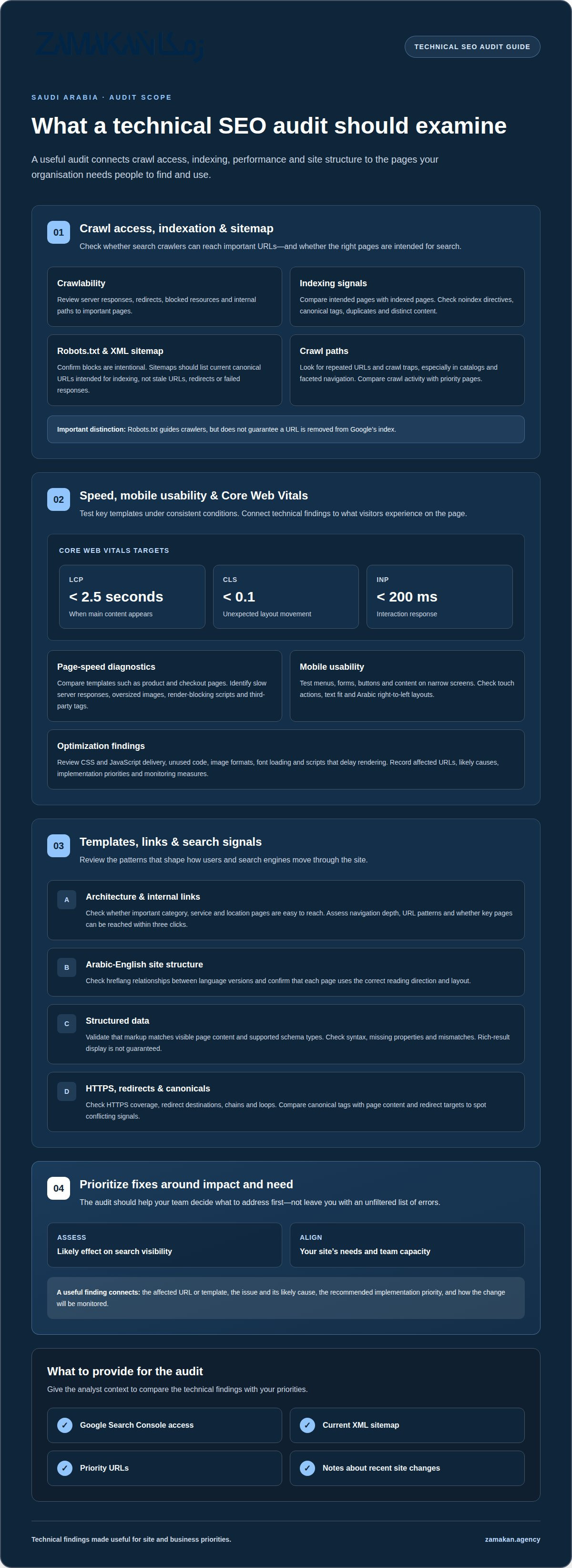
An audit should turn findings into a sequence, not an undifferentiated error list. For a technical SEO audit serving organisations across Saudi Arabia, rank each issue by its effect on search visibility, the importance of affected pages, and the work required to resolve it. This helps your team protect key customer journeys and assign fixes to the right technical owners.
Focus on important pages that are excluded from indexing or point to the wrong canonical URL. Confirm which URLs are affected and whether a shared template causes the issue across multiple pages.
A defect in a shared template may affect many pages, while an isolated broken link may need a narrower fix. Record the affected page groups, likely visibility impact, dependencies, and responsible team.
A redirect change may depend on a URL migration, while template updates may require development resources. Group related fixes so one implementation does not create conflicting signals or duplicate effort.
Resolve errors that block important pages before refining minor details. Then schedule speed, navigation, or structured data changes according to business priorities and development capacity.
For technical SEO audits across Saudi Arabia, document each finding’s affected URLs, evidence, recommended action, owner, and validation method. Google Search Console can help monitor indexing and search performance after implementation; compare relevant pages with their earlier data. This creates a clear record for marketing and development teams, keeping future technical work focused on verified needs rather than a generic checklist.
zamakan Agency helps organisations connect technical findings with marketing priorities, internal resources, and practical next steps. Its SEO/SEM audits examine technical and content issues, giving your team a clearer basis for deciding what to address first. The value is not simply a longer list of errors, but a clearer view of how website performance supports wider goals.
ADVISORY is relevant when your team needs to interpret findings, set priorities, or coordinate decisions across marketing and development. For example, if recommendations compete for limited development time, strategic guidance can help distinguish urgent visibility barriers from work that can be scheduled later. This keeps action connected to business objectives and available resources.
SEO/SEM support fits when you need technical and content audit insights to understand how your website performs in search. Findings can clarify where technical obstacles, page content, and search priorities intersect. BRANDING may be relevant when website structure or messaging does not clearly express your organisation’s identity across key pages and campaigns.
MEDIA services can support broader planning when organic search is one part of your marketing mix. A clearer understanding of your website’s search readiness can inform how teams coordinate organic visibility with paid media activity. The right approach depends on your goals, audience, measurement approach, and capacity to act on recommendations.
With focused findings, your team can move from diagnosis to decisions, assign ownership, and track whether implemented changes address the original issues. zamakan Agency can help align that work with your wider marketing direction, without treating every finding as equally urgent.
Contact zamakan Agency to discuss the next step for your technical SEO audit Riyadh priorities.
SEO/SEM agencies that conduct technical audits provide this service, including Zamakan Agency. Its audits assess technical and content issues affecting search performance, helping your team identify gaps and plan work around organisational priorities. For a useful engagement, prepare access to relevant website and search performance data, identify key business pages, and share recent development changes that could explain sudden shifts.
An SEO audit can identify technical barriers that make it harder for Google to discover, interpret, or rank relevant pages. Fixing an issue may improve a page’s eligibility or experience, but an audit itself does not change rankings. For example, restoring access to an important service page can address one obstacle; content relevance, competition, and implementation also influence search performance.
A technical audit typically examines crawl access, indexing signals, sitemaps, loading performance, mobile usability, internal links, site structure, structured data, and secure page delivery. The auditor should connect findings to specific URLs or templates and explain their implications. For a bilingual Saudi website, the assessment can also review how Arabic and English page versions relate and whether each serves its intended audience.
The scope depends on website size, platform, technical complexity, and the depth of analysis required. A site with multiple templates or language versions can involve different work from a small, simple site. Clarify the website areas to assess, the analysis required, and the deliverables your team needs before the audit begins.
Zamakan Agency offers SEO/SEM technical and content audits. To assess whether an audit meets your needs, look for clear findings tied to specific pages, explanations of likely impact, and recommendations your development team can act on. The scope should reflect your website’s structure and business priorities. Compare deliverables and implementation guidance, not broad promises about rankings.
A professional audit combines a website crawl with Google Search Console data to compare accessible URLs with pages Google reports as indexed. The analysis looks for blocked paths, unexpected exclusions, duplicate versions, and mismatches between intended and indexed pages. You can support this work by providing the current sitemap, relevant access, priority URLs, and context about recent site migrations or releases.