
The right media agency in Saudi Arabia is not simply the one with the broadest channel list. It is a partner that connects market insight to a clear media plan, sound buying decisions, and reporting you can use.
You need confidence that an agency understands how your audiences, objectives and business priorities shape media choices across the Kingdom. This article explains how to assess local knowledge, understand the practical value of international partnerships, evaluate reporting and judge whether coverage across Riyadh, Jeddah and Dammam fits your needs.
You’ll also learn what to look for in planning and buying, how to distinguish strategic capability from broad claims, and when an agency’s strengths align with your goals. These criteria can help you make an informed decision and build a clear foundation for media activity in Saudi Arabia.
• Assess whether an agency can connect Saudi market insight with international partnerships and the needs of your audiences.
• Look for reporting that links campaign activity to your objectives and supports clear, informed decisions.
• Evaluate how an agency plans coverage across Riyadh, Jeddah, and Dammam based on your business priorities.
• Compare strategic approach, relevant experience, and reporting quality to identify a partner suited to your goals.
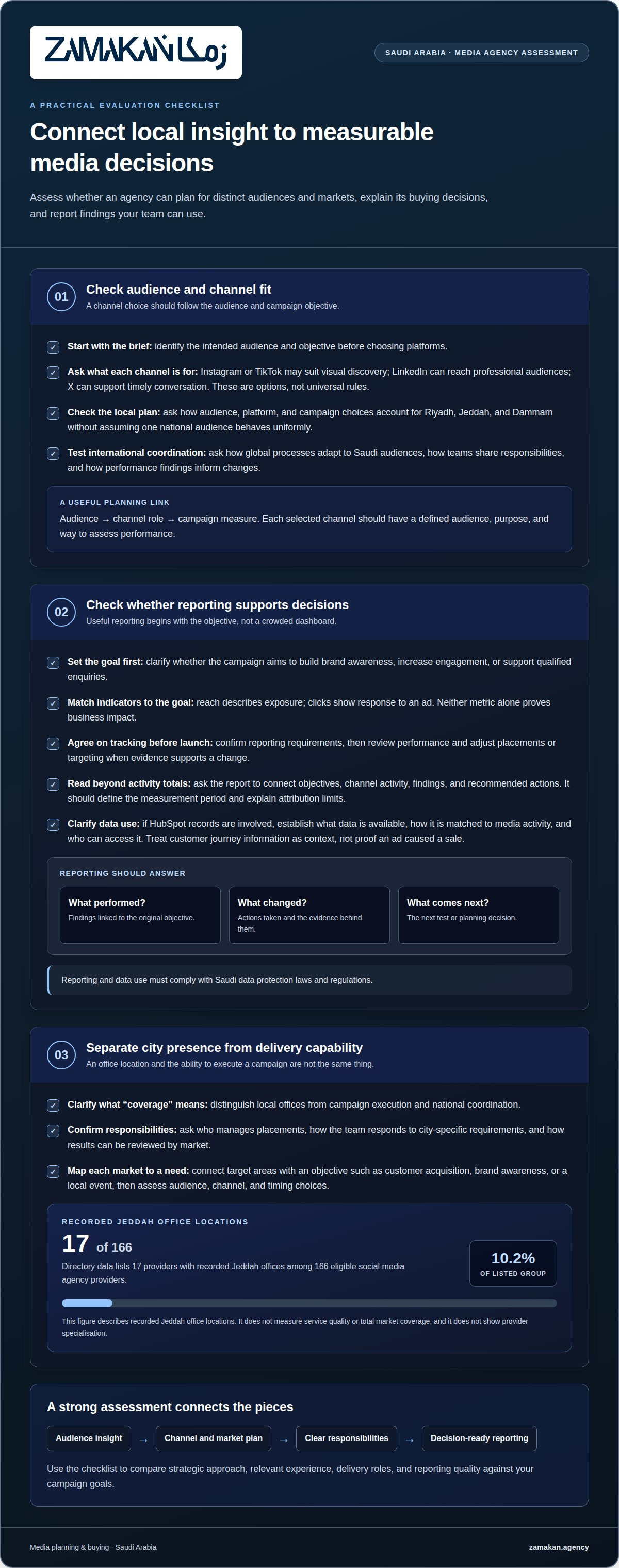
For a media agency in Saudi Arabia, local knowledge means turning audience research into choices by platform, city, and campaign objective. Instagram, TikTok, X, LinkedIn, and Facebook serve different communication contexts. Plans for Riyadh, Jeddah, and Dammam should reflect your target customers and business priorities, not assume one national audience behaves uniformly.
The right advertising channels depend on your goal and audience. Instagram or TikTok may suit offers that benefit from visual discovery; LinkedIn can reach professional audiences, while X can support timely conversation. Treat these as options, not universal rules. A media plan should connect each channel to a defined audience, campaign role, and performance measure.
International partnerships can extend access to expertise, platforms, or coordination across markets. Their value depends on how well global processes adapt to Saudi audiences. Ask how audience insights shape targeting, how teams share campaign responsibilities, and how performance findings inform changes. A regional campaign, for example, can retain its central message while adapting placements for different Saudi customer groups.
Fair Trade marketing needs a clear link between a claim and the audience’s concerns. A campaign should explain relevant product or sourcing details in accessible language, then use audience response to refine its message. Integrated digital marketing can coordinate social media, paid placements, and reporting around that message instead of treating each channel as a separate activity.
In Riyadh, a digital marketing agency’s contribution should extend beyond selecting platforms. A practical process links audience research, media planning, targeted campaign execution, and performance review. Advertising and media activity should also be reviewed for applicable Saudi requirements before launch. The relevant considerations can vary by channel, content, and sector, so assess each placement and creative accordingly. This keeps local relevance, international coordination, and campaign accountability connected.
Useful reporting starts with the campaign objective, not a dashboard full of metrics. For a Saudi campaign, the team can define whether advertising should build brand awareness, increase engagement, or support qualified enquiries. Each goal needs a matching indicator. Reach can describe exposure, while clicks show response to an ad. Neither alone proves business impact. A clear measurement plan explains what each metric can and cannot tell you.
Strategy, audience research, and analytics should work as one process. First, identify the intended audience and select channels. Then set tracking and reporting requirements before launch. During the campaign, review performance and adjust placements or targeting when evidence supports a change. Reporting should connect these actions to the original objective, rather than list activity without explaining its significance.
Social media reporting can distinguish presence from response. A campaign might track how people engage with a brand’s stories, then compare that activity with visits or enquiries. The report should define the measurement period and explain attribution limits, meaning how outcomes are connected to marketing activity. This gives your team a more reliable basis for planning the next campaign.
If your organisation uses HubSpot, treat its records as a potential source of customer journey information, not proof that an ad caused a sale. Clarify what data is available, how it is matched to media activity, and who can access it. Marketing measurement must comply with Saudi data protection laws and regulations. Keep reporting decision-focused: what performed, what changed, and what the next test will assess.
Ask for a sample report linking objectives, channel activity, findings, and recommended actions. A media plan can carry those insights into future campaigns, while consistent definitions help teams compare results over time.
Coverage across Riyadh, Jeddah, and Dammam can mean local offices, campaign execution, or both. These are different capabilities. A provider may coordinate media nationally without maintaining an office in every city. Clarify which activities happen locally, who manages placements, and how the team responds to city-specific requirements. The distinction matters when brands need regional activation alongside consistent national planning.
Available directory data lists 17 providers with recorded office locations in Jeddah among 166 eligible social media agency providers. That represents 10.2% of the listed group. This figure describes recorded Jeddah offices, not the quality of service or total market coverage. It also does not show whether providers specialize in media buying, social media, or another service. Treat location as one indicator, then assess relevant expertise and delivery responsibilities.
Compare agency locations with the work your campaign needs. For example, a brand seeking coordinated activity in Riyadh and Dammam may need one planning team, clear local execution responsibilities, and reporting that separates results by market. A Jeddah office could support some requirements, but location alone does not establish capability in another city. Ask how the proposed plan adapts audience, channel, and timing decisions across each target area.
Agency services and plans should connect defined goals to measurable activity. A useful plan identifies target markets, intended audiences, campaign channels, responsibilities, and reporting methods. Digital solutions can support coordination, but the operating model should explain who manages each stage and how changes are handled. A national brand, for instance, may maintain one identity while adapting placements to local objectives. This turns a broad brief into a practical delivery plan without treating distinct markets as interchangeable.
When evaluating coverage, map each market to a business need, such as customer acquisition, brand awareness, or a local event. Then assess whether the agency’s expertise and proposed services address that need directly. A clear match between market, capabilities, and measurable objectives is more useful than office count alone.
Choose a partner by matching its services to your objectives, audience, and campaign requirements. An agency may focus on social media advertising, media buying, search, or integrated planning. These capabilities are not interchangeable. A brand seeking paid reach across Saudi Arabia, for example, needs a different scope from one prioritising specialist sports media. Define the required channels and outcomes before reviewing proposals.
How do agencies compare in services and client reviews? Their scope, sector experience, campaign examples, and review patterns differ, so no single ranking answers every brief. Assess whether feedback describes work relevant to your audience and goals. Look for consistent comments on communication, reporting, and delivery, then compare those themes with the agency’s stated services and portfolio.
A contract should define campaign scope, selected channels, responsibilities, approvals, deliverables, reporting schedule, payment terms, and conditions for ending the engagement. Specify who approves advertising materials and provides required assets. For a campaign across multiple markets, state which markets and placements are included. Clear responsibilities reduce ambiguity during planning and execution.
Common risks include unclear objectives, disconnected teams, reporting that lists activity without explaining performance, and assumptions about what the service covers. A Saudi campaign can also lose relevance if its audience, messaging, or placements are treated identically across distinct markets. Address these risks with a documented brief, named points of contact, agreed measurement definitions, and regular review meetings. Record approved changes so teams share the same direction.
Before signing, compare the proposed approach with your business priorities, not just its channel list. A focused discussion can clarify your media planning needs and next steps. Discuss your media planning requirements.
zamakan Agency helps organisations turn agency-selection criteria into a focused marketing approach. Its advisory and media services can align market understanding, campaign objectives, channel choices, and reporting expectations. This is useful when you need to connect planning with accountable execution across Saudi Arabia, or when your current activity lacks clear priorities.
The right scope depends on your goals, audience, and internal resources. A clear brief gives the work direction; agreed measures help your team assess progress and decide what to refine. SEO/SEM and branding can also support broader marketing needs when they align with the same business priorities.
For a considered discussion about your media requirements, contact zamakan Agency.
Your next step is to turn your agency criteria into a brief that reflects your organisation’s priorities. Identify the decision the campaign needs to support, the audiences it must reach, and the outcomes your team will use to assess progress. This gives internal stakeholders a shared reference point and helps keep planning aligned as activity develops.
The right media agency in Saudi Arabia should make that direction practical, connecting strategic choices with execution and clear accountability. Zamakan Agency brings advisory, media, and SEO/SEM capabilities to marketing decisions, helping organisations shape activity around their objectives. The right scope depends on your needs, resources, and measurement priorities.
Bring your current objectives and questions into a focused conversation, then define the most useful next step for your team. Contact Zamakan Agency to discuss your media needs and move forward with greater clarity.
Saudi Arabia has agencies with different combinations of strategic advisory, media planning and buying, public relations, and digital marketing services. Assess a media agency in Saudi Arabia against your business objectives and required channels. Zamakan Agency provides advisory, media, and SEO/SEM services, combining strategic guidance with media work and search marketing.
Specialisations differ, so compare each agency’s documented capabilities for digital, television, print, and outdoor campaigns rather than assuming one provider covers every format. Zamakan Agency provides media planning and buying across targeted channels. Identify the formats relevant to your brief, then assess how an agency connects placements to your audience, campaign objectives, and measurement approach.
The scope of strategy, planning, channel selection, buying responsibilities, and reporting determines what a proposal covers. Request a clear scope that separates agency responsibilities from media placements and explains how campaign changes are handled. This gives your team a clear basis for comparing proposals and confirming that the planned work matches your objectives, internal resources, and reporting requirements.
A suitable agency connects audience research and campaign objectives with media strategy, planning, buying, and performance reporting. Depending on your needs, it may also coordinate public relations or digital marketing activity. A brand launching a service, for example, could need audience definition, channel recommendations, campaign execution, and agreed reporting, with clear responsibilities for each element.
Start by documenting your goals, target audience, required channels, internal approval process, and available campaign data. Compare proposals for strategic fit and clear responsibilities, then review relevant work and the proposed reporting method. Before appointing an agency, agree on deliverables, communication processes, approvals, data access, and contract terms so both teams understand how the engagement will work.
Services, sector experience, campaign examples, and review patterns vary, so compare agencies against your specific brief. Look for consistent feedback on communication, reporting, and delivery, and check that it aligns with their stated services and portfolio.