
An integrated media strategy aligns channels around shared objectives and a consistent brand message, so campaigns feel connected rather than fragmented. In Saudi Arabia, its value lies in giving each channel a clear role based on audience needs and business goals, then adapting the message to suit each platform. This article explains why alignment matters, how coordinated campaigns support performance, and how planning differs from buying, giving you a practical basis for assessing your approach.
• Choose channels based on audience research and campaign goals, then give each one a clear role in the customer journey.
• Keep the central brand message consistent while adapting its expression to each platform, and use performance data to refine delivery.
• Study integrated campaign examples to see how coordinated touchpoints can reinforce a message across different channels.
• Set objectives and channel-specific measures before buying placements so you can assess how the plan is working.
Coordinated media gives channels shared campaign objectives and a consistent brand direction. For organisations in Saudi Arabia, audience evidence helps distinguish purposeful coordination from simply appearing across several platforms.
Audience research identifies customer groups, their needs and the channels they use. It matters because channel choices should reflect evidence and objectives, not habit. For example, a national retailer can assess whether shoppers discover products through social media, search or stores before assigning each channel a role. A multichannel approach uses several channels; integration connects them through shared priorities and coordinated messaging.
Unified messaging preserves a brand’s central promise while adapting creative to each platform. This matters when customers encounter an organisation at different touchpoints, where conflicting claims can weaken recognition. A product benefit introduced in a social post should remain clear on its landing page and in search advertising. Formats can vary while the meaning stays consistent throughout the customer journey.
Business goals define the intended outcome, while channel-specific goals clarify each medium’s contribution. A professional builds the plan by agreeing on the objective, researching audiences, selecting channels, assigning roles and measures, and setting review points. For example, a Saudi service campaign might use video to build awareness and search to reach people already seeking that service. Each placement then has a distinct purpose.
Paid media uses purchased placements, owned media includes brand-controlled channels, and earned media covers outside publicity or customer recommendations. A professional aligns them by linking each format to the same campaign message and a useful next step. Paid social can introduce an offer, a brand page can explain it, and customer discussion can extend awareness. This coordinates media rather than simply multiplying placements.
Aligned campaigns connect business priorities with channel roles, timing, team capacity and measurement. That structure helps marketers refine delivery without changing the central promise whenever performance data shifts.
Campaign goals define the business outcome, while objectives translate it into measurable audience actions. A professional sets objectives by linking the intended result to audience segments and channel-specific KPIs. For example, a Saudi retailer might aim to increase product consideration, then track video views and qualified website visits. Clear priorities also help marketing, sales and media teams coordinate responsibilities and keep decisions focused.
Timing and channel prioritisation determine when each channel runs and how it supports the campaign’s objectives. A professional maps campaign periods to customer demand, seasonal activity and the time each message needs to reach its audience. Channels are prioritised according to objectives, audience reach and expected contribution, while taking into account team capacity for planning, creative approvals and campaign monitoring. This helps prevent teams from launching channels they cannot manage effectively.
Campaign testing compares defined variations to identify which execution better supports the objective. A/B testing can compare headlines, formats or audience segments while keeping the core brand message stable. If a digital ad earns attention but few visits, the team can adjust its call to action or placement rather than replace the campaign concept. This disciplined iteration helps brands respond to analytics without fragmenting their communications.
KPIs are measures tied to campaign objectives, and attribution estimates how channels contributed to outcomes. A professional sets objectives first, defines the intended audience, then assigns channel-level KPIs, such as views for video and website clicks for search. Measurement combines those signals with conversion data and earned responses where available. Because consumers may encounter several channels before acting, attribution can indicate contribution without proving that one placement alone caused the result.
Campaign examples show how a central idea can travel across platforms without becoming a collection of unrelated advertisements. Always’ #LikeAGirl campaign used a YouTube video as its centrepiece. Domino’s Anyware campaign generated earned social media impressions and additional website visits. Each illustrates a different strategic consideration: a memorable message needs a suitable platform, while audience response can extend beyond paid advertising.
Always placed video at the centre of a campaign about the phrase “like a girl.” The practical lesson is not to copy its format, but to identify what makes the message meaningful to its audience. A brand can then adapt the idea for other touchpoints while keeping its meaning consistent. For example, a short social post might introduce the theme, while a longer video provides context. Each execution serves the same awareness goal without repeating identical creative.
Domino’s Anyware offers another useful lens: an integrated campaign can connect marketing communication with a practical customer action. Its name signals a focus on access across different contexts, while the campaign’s reported social impressions and website visits show activity across more than one touchpoint. The takeaway for marketers is to map the intended path from exposure to purchase. Each platform should help consumers take a next step, not merely repeat an advertisement.
Consider a hypothetical Saudi retailer introducing a new product. It could use outdoor advertising to establish awareness, social content to explain product benefits, and search advertising to reach people actively exploring purchase options. The message stays consistent, but each format addresses a different audience need. Measurement should distinguish exposure, engagement and visits so the team can see where the journey gains momentum.
Across Always, Domino’s and the hypothetical retailer, integration means coordinated roles, not identical placements. The best example for your brand depends on its audience, objective and the action each channel needs to support.
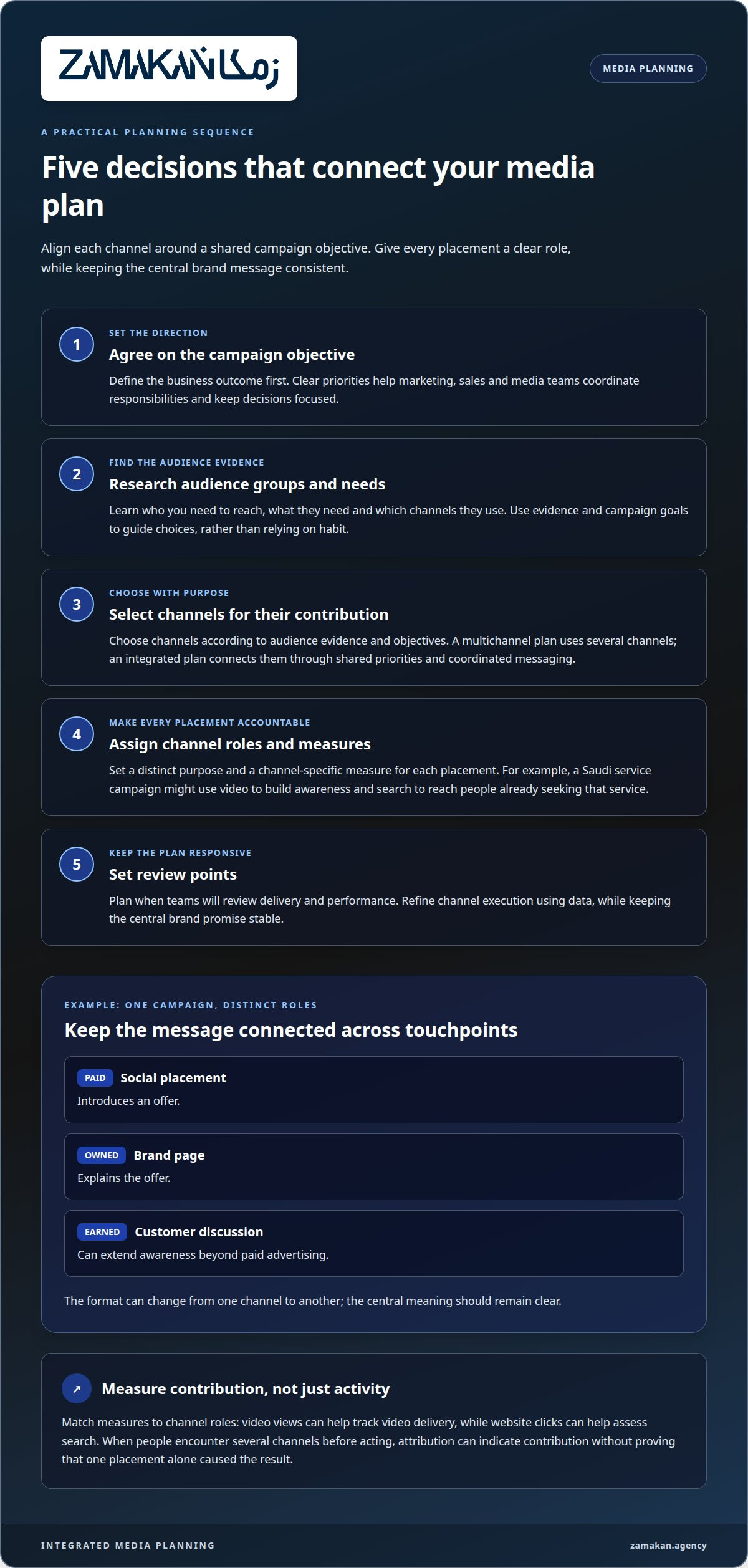
An effective integrated media plan connects business objectives, audience evidence, channel roles, execution and measurement. Before selecting placements, media planners define target segments, timelines, key performance indicators (KPIs) and channels.
These elements form a decision framework, not a checklist of separate tasks. For example, a Saudi retailer’s product launch could require audience segments, a launch timeline and measures for awareness and website visits. Each decision should support the same business outcome. If the objective changes, the channel mix and measures may need to change too.
State the business outcome, such as increasing brand awareness or generating qualified website traffic. This gives each channel a purpose.
Define which customers the campaign needs to reach and what they need at each stage of the customer journey.
Specify how paid, owned and earned media contribute. For example, paid search can capture active product interest, while owned content explains product details.
Map campaign phases according to the role and priority of each channel.
Assign channel-specific indicators, then review them alongside campaign objectives.
Coordination turns these components into a working plan. A video placement might introduce a product, a landing page explain its benefits, and paid search reach people seeking a solution. Teams need shared timelines and clear approval responsibilities so creative materials, placements and destination pages are ready together. This also helps prevent a channel from running before its supporting customer experience is in place.
Measurement tools can include Google Analytics and social media insights, alongside relevant sales data. Use them to compare each channel’s contribution against its assigned KPI, rather than treating clicks, views and conversions as interchangeable. Review results regularly, document changes and connect each adjustment clearly to the objective it supports.
zamakan Agency connects media planning and buying decisions to campaign objectives, audience evidence and channel roles. Its advisory and media services can help when placements feel disconnected, priorities are unclear, or campaign measurement does not show how channels contribute.
Planning sets the audience, objectives, channel mix, timing and measures before placements are purchased. Buying turns that plan into media placements and campaign activity. Keeping the decisions connected gives your team a clearer basis for reviewing performance and adjusting delivery. SEO/SEM can also support campaigns where search visibility is relevant to the wider media plan.
Contact zamakan Agency to discuss a more coordinated approach to your media planning and buying.
Your next planning conversation can begin with one decision: what must change for the business, and what evidence will show progress? Once that priority is clear, teams can agree who owns each decision, which signals deserve attention, and when to revisit the plan. This makes an integrated media strategy an operating discipline, connected to daily marketing decisions rather than set apart from them.
A useful starting point is identifying the uncertainty that most limits confident action, whether it concerns audience priorities, channel contribution or internal ownership. Addressing that first helps keep the next plan practical and focused. Zamakan Agency’s strategic team can frame those decisions around your organisation’s objectives and the questions your campaign needs to answer.
Bring your priorities and current challenges into a focused discussion, then define a clear direction for what comes next. Contact Zamakan Agency to discuss your strategy and take the next step with confidence.
Yes. One team can plan and buy media, provided planning decisions guide placement choices and campaign monitoring. This can reduce handover gaps, such as a buying team receiving outdated audience priorities. For example, if a product launch date shifts, the same team can review timing and placements together. Clear approval roles still matter, especially when your organisation’s marketing, legal and sales teams contribute.
Integrated marketing coordinates an organisation’s communications across marketing activities, not only its advertising placements. It can connect public relations, social media, search and customer-facing materials around a shared positioning. For example, a service launch might use a media announcement, social posts and updated website information that express the same value proposition. The exact mix depends on the audience and the business outcome the organisation needs.
An integrated media strategy is a plan for coordinating media channels so each supports a shared campaign objective. It guides decisions about audience, placements, timing and how success will be assessed. For a new service, a team might combine an awareness channel with search advertising that reaches people already exploring solutions. The plan connects those roles while allowing the message format to suit each placement.
Professionals select media channels by weighing campaign objectives, audience access, channel requirements, timing and available performance evidence in Saudi Arabia. A business focused on product discovery may prioritise channels that build reach, while a campaign aimed at active buyers may give more weight to search. Planners also leave room to test assumptions and review delivery, rather than relying solely on the previous campaign’s channel choices.
Integration can make brand communications more coherent and help teams compare channel contributions against shared goals. The main risks include unclear ownership, inconsistent data and overcomplicated measurement. For instance, if social and search teams use different conversion definitions, their reports may not support a sound decision. Agreeing on shared campaign definitions and documenting channel roles helps limit that risk while preserving each channel’s distinct purpose.