
Marketing attribution modeling for enterprise teams assigns credit to the marketing touchpoints associated with a conversion, helping you understand how channels contribute to growth. No single model tells the whole story: first-touch, last-touch, and multi-touch approaches answer different questions, while marketing mix modeling offers a broader view of channel impact. This guide compares the models and explains how to build and validate an approach across fragmented systems, long sales cycles, and complex customer journeys.
• Reconcile platform, CRM, and customer-reported sources so attribution reflects a shared view of outcomes rather than disconnected reports.
• Choose a model based on your sales cycle, journey complexity, business goals, and the quality of your available data.
• Use marketing mix modeling alongside touchpoint attribution when you need a broader view of channel contribution and budget allocation.
• Connect measurement decisions to practical media planning and marketing priorities, with clear ownership for maintaining data quality.
Validate attribution by reconciling marketing-platform, sales-recorded, and customer-reported data against shared conversion definitions. For organizations in Saudi Arabia, this creates a consistent basis for reviewing recorded touchpoints across the customer journey. The marketing attribution modeling enterprise teams use should support practical decisions, not simply combine platform reports. Compare results with CRM outcomes and examine which interactions the tracking captures.
Data-driven attribution assesses how recorded touchpoints relate to conversions, rather than relying only on fixed credit rules. It helps you examine interactions across the funnel while accounting for the limits of available journey data. Test model outputs against 20 to 30 historical closed-won deals, then compare the attributed sources with sales records. A marketing attribution modeling enterprise teams can use should make those assumptions visible, especially when B2B buying groups and B2C purchase paths differ.
Integrate marketing automation, CRM, analytics, ad platforms, a data warehouse, and business intelligence (BI) reporting. For example, align campaign identifiers in Google Analytics with CRM opportunity records, then consolidate agreed fields in a warehouse. Analysts can then trace a conversion from an ad interaction to a sales outcome. Consistent definitions for leads, accounts, and opportunities help teams interpret reports without treating each platform’s conversion total as a separate customer.
Data quality means tracking interactions consistently, handling duplicate records, and recording consent-related gaps. Summed platform conversions can reach 150-250% of actual closed customers, while advertising-platform revenue totals can equal 3x actual revenue. Revalidate attribution every quarter and after tracking, consent, or MarTech changes. Browser cookie restrictions can obscure parts of a journey, so document which touchpoints are captured and which are absent. This context helps Saudi teams interpret model outputs carefully and avoid treating incomplete tracking as a full account of customer activity.
Build a model around the buying journey, the data available, and the decisions your reports need to support. A warehouse-based architecture can consolidate touchpoints from platforms, campaigns, and offline activity.
An attribution model defines how conversion credit is distributed across campaign touchpoints. First-touch credits discovery, while linear attribution divides credit evenly; time-decay gives greater weight to interactions nearer conversion. Position-based attribution assigns 40% to the first touchpoint, 40% to the last, and 20% to middle touches. Custom-weighted rules adjust those shares to match business priorities. Data needs for machine-learning-based attribution vary by implementation; 18 months of clean historical data and a Snowflake or BigQuery foundation are not universal requirements.
Account-based attribution connects marketing interactions to an organization and its buying group, rather than treating each contact as an isolated journey. This matters when campaigns influence several people before an opportunity advances. Include offline interactions, such as field events or sales meetings, when CRM records capture them consistently. A warehouse can join account, campaign, and opportunity data, giving reports a shared structure for digital and non-digital activity.
Rule-based attribution applies explicit credit rules, while multi-touch attribution considers several interactions in one journey. For position-based attribution, assign 40% to the first touch and 40% to the final touch, then divide 20% among middle interactions. A W-shaped model assigns 30% each to first touch, lead creation, and opportunity creation, with 10% shared across middle touches. For enterprise deals with 10 or more touchpoints, assess whether a W-shaped model fits the available data and reporting needs. Set campaign and account tracking fields before integration, then compare model outputs against closed-won records. This makes the model’s assumptions visible and keeps budget discussions tied to consistent reports.
Attribution models differ in how they assign conversion credit across marketing interactions. For enterprise teams, the choice shapes how you interpret influence, revenue, and campaign performance.
Single-touch attribution assigns all conversion credit to one interaction, making it easy to read but limited for complex journeys. First-touch gives 100% credit to the journey’s opening touchpoint, highlighting channels that introduce a brand. Last-touch gives 100% to the final touchpoint before purchase, emphasizing conversion activity. For example, a prospect might discover a service through search, attend an event, then convert after a sales follow-up. Each model selects a different interaction as the reported driver.
Multi-touch attribution distributes credit across several interactions, helping you assess more of an enterprise journey. Linear attribution gives each touchpoint an equal share; in a five-touchpoint journey, each receives 20%. Time-decay gives more credit to interactions closer to conversion. One example uses a 7-day half-life, assigning roughly 50% to the conversion-day touchpoint. This can suit B2B SaaS sales cycles lasting 6 to 10 weeks, but may undercount early demand creation in 120-day sales cycles.
Enterprise journeys can span Google Ads, email, CRM activity, sales calls, and offline events. Multi-touch reports can include these interactions when tracking connects them to the same person or account. For example, an offline event may spark interest, while a later CRM-recorded meeting advances an opportunity. Leaving either out shifts apparent influence toward the channels digital tracking captures most clearly.
Use first-touch to assess discovery and last-touch to review conversion activity, rather than treating either as a complete account of revenue influence. Linear attribution offers a balanced view when touchpoints matter similarly; time-decay suits journeys where recent interactions carry more decision weight. Compare these outputs with CRM outcomes before optimizing budgets. Choose a model to fit the business question, channel coverage, and journey data available.
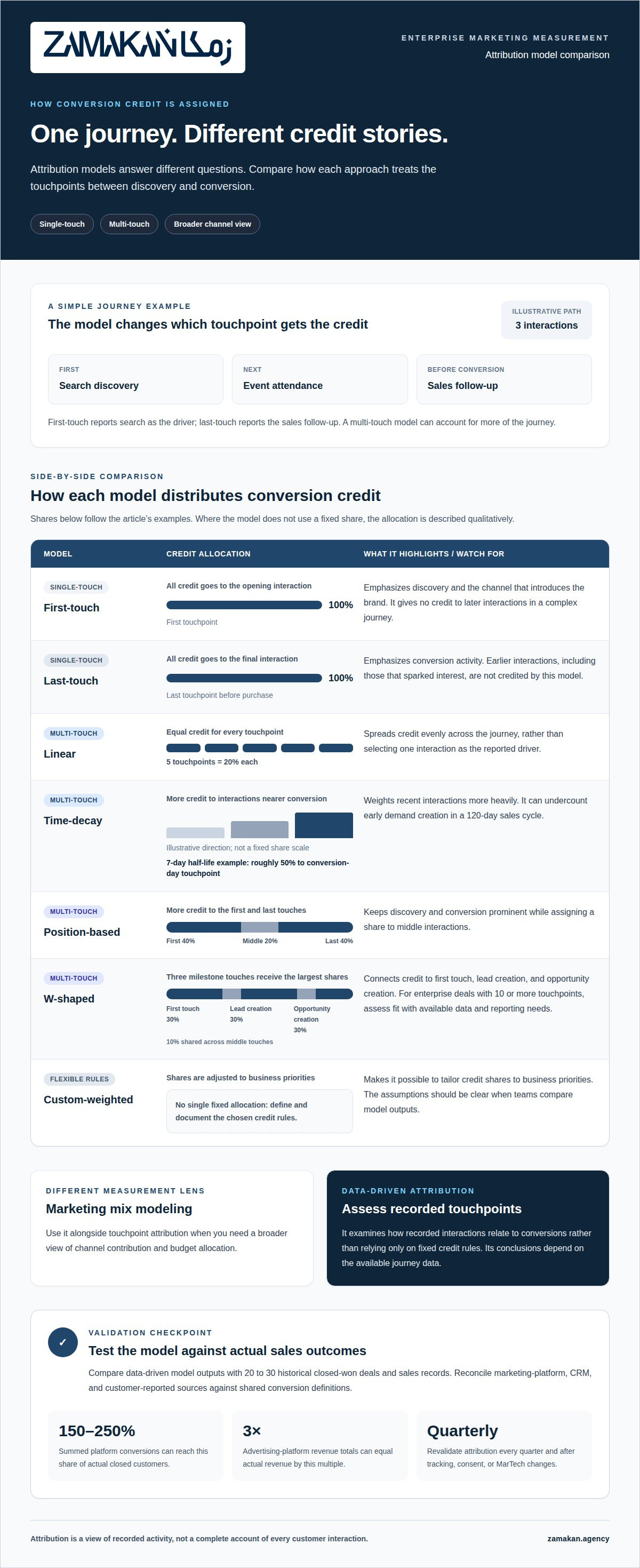
Touchpoint attribution and marketing mix modeling answer different measurement questions. Attribution traces interactions along a customer journey; marketing mix modeling (MMM) estimates how channels relate to outcomes over time. Enterprise teams can use both: one examines recorded paths, while the other supports broader allocation decisions across a complex media mix.
Attribution models use journey-level interactions, such as ad clicks, email responses, and CRM activity, to show which recorded touchpoints receive credit before a conversion. However, they can miss offline activity, cross-device behavior, or journeys that tracking cannot connect. A report may describe recorded influence without capturing every factor behind actual sales.
MMM uses historical channel activity and business outcomes to estimate contribution at an aggregate level. It can include paid media and other factors that shape demand, rather than relying only on identifiable user paths. Treat 100 weeks of historical weekly spend and outcome data as a planning benchmark, not a fixed requirement; 150+ weeks may provide a stronger basis for separating seasonality from media effects. This makes the approach more useful for long-range allocation decisions than for evaluating an individual interaction.
Use MMM when the decision concerns a complex media mix or a large budget allocation. Use touchpoint attribution to inspect how campaigns appear across a customer journey. For example, a team might assess digital interactions in attribution reports, then use MMM to compare broader channel patterns over time. Neither method alone proves that a channel caused a sale; each depends on its inputs, assumptions, and measurement scope.
For enterprise decisions, align both methods with the same outcome, such as qualified opportunities or closed revenue. Before interpreting results, consider whether the sales cycle, seasonality, and available data suit the question. Using both methods gives decision-makers a clearer view of recorded interactions and aggregate channel effects, helping distinguish campaign-level optimization from strategic allocation.
zamakan Agency connects attribution insights with marketing priorities through Advisory and Media. If reports show different channel contributions, Advisory can help clarify which decisions the findings should inform. Media planning and buying can translate agreed priorities into coordinated campaign choices. This is useful when reviewing channel allocation, planning campaigns, or aligning measurement with business goals. Attribution depends on the quality and scope of the underlying data, so clear definitions and realistic interpretation matter. Contact zamakan Agency to connect measurement insights with practical marketing decisions.
Start by connecting measurement to a decision your team needs to make. Define the business outcome that matters, who will use the findings, and how they should shape future planning. This gives enterprise marketing attribution modeling a practical role beyond reporting channel credit. It also helps teams distinguish a useful signal from a number that cannot guide action.
Zamakan Agency brings Advisory, Media, and SEO/SEM perspectives to marketing decisions, connecting channel activity with strategic priorities. Attribution analysis can show where to investigate, while business context guides how to interpret the findings. Treat the model as a decision aid, not a standalone verdict on performance.
If you’re ready to connect measurement with your marketing priorities, contact Zamakan Agency about attribution. A clearer decision framework can help your team move forward with greater focus.
Marketing attribution assigns credit to marketing interactions associated with a business outcome. It connects activity, such as a search visit or campaign response, with a conversion or opportunity. Attribution shows how a chosen model interprets recorded interactions; it does not, by itself, prove that marketing caused the outcome. Use it to inform decisions alongside sales context and business results.
Record offline activity in the same account and opportunity context used for digital campaigns. For an event, capture attendance, event name, date, account, and related sales follow-up in CRM. For account-based marketing, connect interactions from different contacts to their shared account, then review whether the account advanced. This preserves context when an event or several stakeholders influence a deal.
Lead with the business decision the report supports, then show the outcome, attribution method, and data scope. Separate closed revenue from pipeline, and distinguish sourced activity from influenced activity. Include the reporting period and explain which channels or interactions the model could not capture. A clear caveat about coverage helps a CFO interpret the figures without treating attributed revenue as proof of incremental impact.
Time-decay attribution gives more credit to interactions closer to conversion, based on a chosen decay curve or half-life. The setting determines how quickly earlier touchpoints lose weight, so align it with the sales cycle and decision under review. A short decay window emphasizes late-stage activity; a longer one gives more weight to earlier interactions. Compare the result with another model before changing channel priorities.
There is no single average touchpoint count that applies across B2B journeys. The count depends on how your organization defines an interaction, which systems record it, how long the sales cycle lasts, and how many stakeholders participate. A webinar attendance, a sales meeting, and an ad impression may all count differently. Set a consistent tracking definition before comparing journeys or campaigns.
Measure attribution by comparing model outputs with CRM business outcomes, such as qualified opportunities and closed revenue. Check whether tracked campaigns connect to the intended account, conversion, and reporting period. Then assess whether the model changes a decision, such as channel allocation or campaign planning. Track data completeness and model assumptions alongside performance to distinguish a useful signal from a reporting gap.